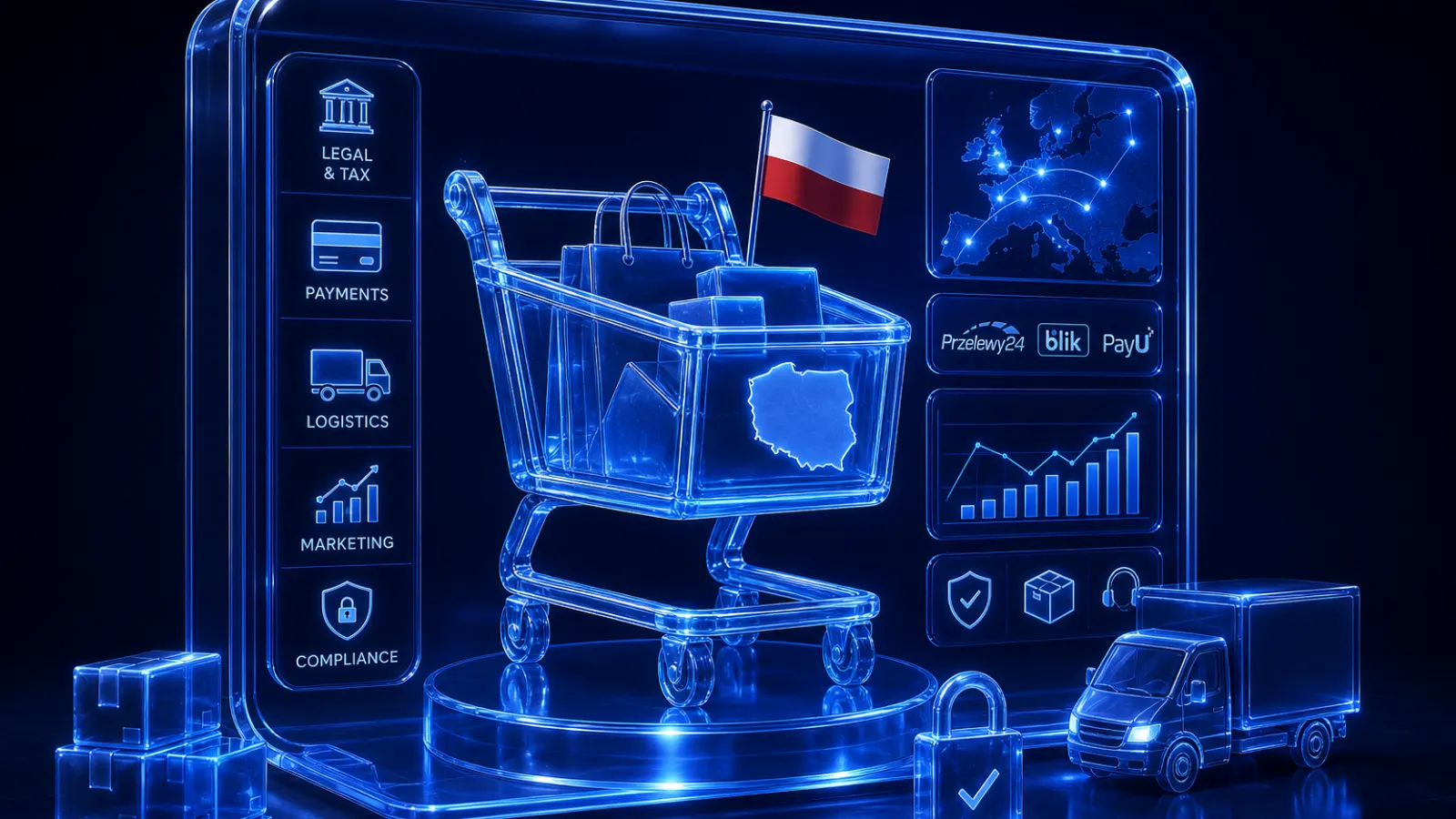
Opening an online store in Poland for Ukrainian entrepreneurs is a promising step that requires a deep understanding of local legislation and market specifics. In 2026, it's not just about registering a business and launching a website. It is necessary to carefully examine the grounds for conducting business, choose the optimal legal form, taxation system, PKD codes, and comply with requirements for consumer protection, product safety, personal data processing, and international sales rules.
Particular attention should be paid to the changes that came into force on March 5, 2026. After this date, the ability of Ukrainians to register sole proprietorships (JDG) in CEIDG depends not only on having a regular PESEL number. The simplified basis remains temporary protection status, confirmed by PESEL UKR. Alternatively, JDG can also be opened with another residence document that allows doing business on the same terms as Polish citizens.
Key Steps to Launch an Online Store in Poland
For a Ukrainian entrepreneur to successfully open an online store in Poland, ShockWave Trade analysts recommend considering the following basic stages:
- Ensure a legal basis for conducting business in Poland.
- Choose the organizational and legal form: unregistered activity, JDG, or Spółka z o.o.
- Prepare the necessary documents: passport, PESEL, PESEL UKR, or relevant residence permit.
- Register the business in CEIDG (for JDG) or KRS (for Spółka z o.o.).
- Select current PKD 2025 codes that correspond to the store's business area.
- Determine the optimal taxation form and the need for VAT registration.
- Register with ZUS and explore available benefit programs.
- Set up a bank account, payment services, and an accounting system.
- Develop legal documents: regulamin (store regulations), privacy policy, return policy, and complaint procedures.
- Check requirements for cash registers, KSeF, BDO, GPSR, OSS, and other specific regulations depending on products and sales geography.
This is a general plan, each point of which requires detailed elaboration.
Legal Grounds for Doing Business for Ukrainians
Polish citizenship is not a mandatory condition for opening an online store. However, the possibility of registering a specific business form is closely related to the Ukrainian's residence status in Poland.
As of March 5, 2026, simplified rules for sole proprietorships primarily apply to Ukrainians who have temporary protection and an active PESEL UKR status. Without PESEL UKR, the entrepreneur will need another legal basis that allows conducting business, for example, a relevant permanent or temporary residence permit, or long-term EU resident status.
If a business was registered and actively conducted before March 5, 2026, it can continue based on acquired rights. It is important to regularly check the relevance of the UKR status. Loss of status (for example, due to a long departure from Poland or lack of identity confirmation with a valid travel document by August 31, 2026) may affect the right to conduct JDG if there is no other appropriate basis for stay.
Choosing the Organizational and Legal Form for an Online Store
Most online store owners choose one of three main options:
1. Unregistered Activity (Działalność nierejestrowana)
This form is ideal for initial business idea testing and small sales volumes. It does not require official company registration but has income limits. As of January 1, 2026, quarterly income should not exceed PLN 10,813.50 (225% of the minimum wage). If this limit is exceeded, the activity becomes entrepreneurial, and an application to CEIDG must be submitted within seven days.
Other conditions include not having registered a business within the previous 60 months. Despite the lack of registration, the seller is still obliged to comply with consumer protection rules, providing information about themselves, pricing, delivery, returns, and complaints. This form is not suitable for large-scale projects with warehouses, constant advertising, and employees.
2. Sole Proprietorship (Jednoosobowa działalność gospodarcza, JDG)
JDG is the simplest option for a single-owner entrepreneur. Registration is done through CEIDG online (Biznes.gov.pl), in person, or by mail with a notarized signature. The registration process and changes to CEIDG records are free.
Advantages of JDG:
- Fast registration.
- Relatively simple accounting.
- Ability to use ZUS benefits.
- No requirement to contribute share capital.
- Convenience for small and medium-sized businesses.
The main disadvantage is that the owner is fully liable for business debts with their personal assets.
3. Limited Liability Company (Spółka z ograniczoną odpowiedzialnością, Sp. z o.o.)
Spółka z o.o. is appropriate for partnership businesses, large turnovers, imports, owning a warehouse, or selling goods with increased legal risks. The minimum share capital is PLN 5,000. Registration takes place in the National Court Register (KRS) through the S24 system or notarially.
Spółka z o.o. requires full accounting. In addition to corporate income tax, separate taxation of dividends may arise. It is important to carefully calculate the tax implications rather than relying solely on promotional promises. Under certain conditions, even a sole participant of an Sp. z o.o. may have obligations to ZUS.
Required Documents and Registration
Documents for JDG Registration
For JDG, the following are typically required:
- Valid passport or other identity document.
- PESEL number.
- Confirmation of PESEL UKR or other basis for conducting business.
- Profil Zaufany, e-dowód, or a qualified electronic signature for online registration.
- Residential address and, if necessary, business activity address.
- Legal basis for using the premises (lease agreement, ownership).
- Business name (entrepreneur's first and last name with a possible brand addition).
- Date of commencement of activity.
- PKD 2025 codes.
- Chosen form of taxation.
- Data for ZUS registration.
- e-Doręczenia electronic delivery address.
After registration, information is automatically transmitted to the tax office, GUS, and ZUS.
Documents for Spółka z o.o.
For a company, the following will be needed:
- Passport data of partners and management board members.
- Company name and legal address.
- Memorandum of association (articles of association).
- Information on participants' shares.
- Amount of share capital.
- Composition of the management board.
- Electronic signatures or Profil Zaufany for S24.
- Application to KRS.
- Confirmation of capital contribution.
- Data for tax registration and accounting.
Step-by-Step Launch Guide
Step 1. Verifying the Right to Conduct Business
Before any investments, it is critically important to ensure the PESEL UKR is active or that there is another legal basis for JDG registration. If there is no right to CEIDG, Spółka z o.o. may be an alternative, but the foreigner's right to be a founder and work in the company requires separate verification.
Step 2. Defining the Product Assortment
The assortment affects PKD codes, VAT rates, the need for special permits (e.g., Sanepid for food products), packaging and labeling requirements, and liability for product safety. It is important not to assume that a product is allowed to be sold online just because others offer it.
Step 3. Choosing the Store's Operating Model
Common models include:
- Own warehouse: full control, but requires working capital.
- Purchase after order: reduces risks but may increase delivery time.
- Dropshipping: minimal initial investment, but it is necessary to clearly define responsibility for information, delivery, and returns.
- Marketplace: sales through platforms like Allegro, Amazon. An own website is not mandatory, but tax and consumer requirements remain.
- Own website + Marketplace: a combined approach for starting up.
Step 4. Financial Calculation and Business Plan
Even for a small store, a detailed financial plan is necessary. It should consider not only the purchase and retail price but also advertising costs, delivery, returns, accounting, payment commissions, packaging, taxes, and potential losses. It is recommended to create three scenarios (minimal, realistic, negative) and provide for a reserve.
Step 5. Choosing the Name, Address, and PKD Codes
The JDG name must contain the entrepreneur's first and last name. Spółka z o.o. can have a separate name. It is important to choose current PKD 2025 codes in accordance with the actual activity. Old codes should not be copied automatically: the current GUS classifier must be used.
Step 6. Registering JDG in CEIDG or a Company in KRS
Online registration via Biznes.gov.pl is convenient for JDG. The application includes all key data: start date, name, addresses, PKD, taxation form, ZUS data, accounting information, bank account, and e-Doręczenia. Since 2025, registering companies create an e-Doręczenia address during registration. It is important to beware of fraudulent offers for paid registration in private "company registers," as official registration is free.
Step 7. Choosing a Form of Taxation
For JDG, the following are available:
- Tax scale: rates of 12% and 32%, income tax after deducting expenses. Profitable with significant expenses.
- Flat tax: 19% rate on profit. Considered for high profits but limits benefits.
- Ryczałt from registered income: tax is paid on turnover without deducting expenses. The rate depends on the type of activity. Not always the cheapest option for stores with low margins and high costs.
Step 8. Registering with ZUS
New entrepreneurs can use "Ulga na start" (start-up relief) for six months without paying social contributions (medical contributions remain mandatory). After this, preferential social contributions are available for 24 months. Since 2026, the rules for "Mały ZUS Plus" have changed, allowing reduced contributions for up to 36 months. However, benefits have disadvantages: absence of insurance payments during this period.
Step 9. VAT Registration
As of January 1, 2026, the VAT exemption limit in Poland has been increased to PLN 240,000 per year. However, the exemption does not apply to all goods and operations. VAT registration may be beneficial if the store buys a lot from VAT payers, imports goods, works predominantly with B2B clients, or plans active trade within the EU.
Step 10. Setting up OSS for Sales in the EU
When selling to consumers in other EU countries, it is necessary to control the overall limit of cross-border B2C sales of EUR 10,000 (PLN 42,000). After exceeding this threshold, VAT is paid at the rate of the buyer's country. The VAT OSS system allows submitting a single declaration through the Polish tax administration, avoiding registration in each country. Dropshipping from non-EU countries requires special attention to import, VAT, and customs issues.
Step 11. Opening an Account and Connecting Payments
A separate business account significantly simplifies accounting, verification of receipts, refunds, and integration with payment systems. When choosing a payment operator, one should compare not only commissions but also payment terms, available payment methods (BLIK, cards, Apple Pay, Google Pay), and conditions for foreign owners.
Step 12. Cash Register Check
Even an online store is not always exempt from the obligation to use a cash register. The obligation depends on the type of product, payment method, turnover, and the ability to unambiguously link a bank payment to a specific buyer and order. It is important to consult an accountant to avoid errors.
Step 13. Preparing the Store for KSeF
In 2026, the Krajowy System e-Faktur (KSeF) became mandatory in stages. A store that sells to legal entities or entrepreneurs must check the integration of its platform, accounting, and KSeF in advance. Access to the system is necessary to receive documents from suppliers.
Step 14. Website Creation and Legal Pages
The online store platform must support the Polish language, VAT, delivery, returns, and local payment methods. In addition to the catalog, the following pages are mandatory:
- Store Regulations (Regulamin sklepu internetowego): describes order, payment, delivery, return, and complaint conditions. Must correspond to the store's actual operations.
- Privacy Policy: explains the processing of personal data.
- Cookies Policy: necessary technical cookies can be used without consent; others only after conscious user choice.
- Return Policy and Withdrawal Form: clear instructions and a ready-made form.
- Complaint Policy: informs the buyer about the procedure and deadlines.
Step 15. Order Process Configuration
Before purchase, the consumer must see full product information, price, taxes, delivery, and terms. The checkout button must clearly indicate a payment obligation (e.g., "Zamówienie z obowiązkiem zapłaty"). Paid services should not be automatically added to the cart.
Step 16. Adhering to Return Rules
A consumer has the right to withdraw from a contract within 14 days without giving a reason. The store is obliged to refund the payment, including the cost of the cheapest standard delivery method offered by the store. There are exceptions to the right of return, which must be clearly described in the regulamin and applied only when legal grounds exist.
Step 17. Organizing Complaints
Since 2023, the key concept in consumer relations has been the non-conformity of goods with the contract. The seller is responsible for repair, replacement, price reduction, or contract termination. A response to a complaint must be provided within 14 days. Responsibility cannot be automatically shifted to the manufacturer.
Step 18. Rules for Promotions and Reviews
When announcing a discount, the lowest price that was active 30 days before the discount must be indicated next to the current price. Avoiding "dark patterns" such as fake timers or endless discounts is critical. If the store publishes reviews, it must inform whether it verifies their authenticity and how it does so.
Step 19. Product Safety under GPSR
The General Product Safety Regulation (GPSR) has been in effect in the EU since December 13, 2024, and applies to all goods sold, including online. Store owners, especially those importing goods from outside the EU, must ensure all necessary documents (conformity certificates, CE marking), instructions in Polish, and safety warnings are available. Our analysts emphasize: relying on "the supplier assured safety" is not enough.
Step 20. BDO Registration
BDO (Waste Database) concerns the accounting of waste, packaging, and products that generate specific waste. An online store may require registration if it is the first to introduce packaged goods to the Polish market, imports packaged products, uses its own packaging, or sells regulated goods (electronics, batteries). Even dropshipping stores that introduce packaged goods to the market may have environmental obligations.
Step 21. Organizing Delivery
Polish buyers appreciate flexible delivery options (courier, parcel locker, pick-up point), clear pricing, and tracking. The store is responsible for the parcel until it is handed over to the buyer. In the contract with the logistics company, it is necessary to check compensation limits, claim submission deadlines, return of undelivered parcels, and cash-on-delivery procedures.
Step 22. Launching Marketing
Without marketing, even the best website does not guarantee sales. At the start, it is worth focusing on 2-3 effective channels: Google Shopping, SEO, marketplaces (Allegro), Meta Ads, TikTok, collaboration with bloggers, email marketing. For SEO, unique product descriptions, specifications, FAQs, and delivery information are crucial. Our experts recommend not copying supplier descriptions but creating original content with own photos and real use cases.
Cost of Opening an Online Store in Poland
There is no universal sum, as projects vary greatly. The budget should include:
- Registration and legal form.
- Accounting, ZUS, and taxes.
- Domain and hosting/platform.
- Design and programming.
- Legal documents.
- Payment integration.
- Product photos and descriptions.
- Product procurement.
- Packaging.
- Warehouse or fulfillment.
- Delivery.
- Advertising.
- Returns.
- Reserve for returns and unforeseen expenses.
JDG registration is free, but this is only a small part of the costs. The largest expenditures are often goods, advertising, and working capital. A practical approach is to calculate expenses for the first three months without expecting profit and add a reserve.
Typical Mistakes of Ukrainian Entrepreneurs
- Registration without status verification: having a PESEL does not always guarantee the right to JDG after March 5, 2026.
- Choosing tax solely based on the lowest rate: a low ryczałt rate can be unprofitable for stores with high expenses.
- Lack of VAT verification: ignoring exceptions or sales within the EU.
- Using someone else's Regulamin: incompatibility of the document with your business model.
- Automatic enabling of advertising Cookies: without user consent.
- Absence of GPSR information: especially for imported goods.
- Ignoring BDO: even a small store may have obligations.
- Fake promotions and reviews: risk of UOKiK claims.
- Lack of return reserve: not accounting for potential product returns.
Checklist Before Launch
Before starting sales, Our experts recommend checking:
- The owner's right to conduct business in Poland and an active PESEL UKR.
- Registration in CEIDG or KRS, current PKD 2025.
- Chosen taxation form, VAT, EU VAT, ZUS, OSS or IOSS.
- Existence of a bank account and connected payment system.
- Requirements for cash registers, KSeF, e-Doręczenia, BDO, GPSR.
- Need for industry-specific permits (e.g., Sanepid).
- Existence and compliance of Regulamin, privacy policy, cookies banner, return forms, and complaint procedures.
- Adherence to promotion and review rules.
- Agreements with suppliers and availability of product documents.
- Organization of delivery and accounting.
Frequently Asked Questions
Can a Ukrainian open an online store in Poland without Polish citizenship?
Yes. Polish citizenship is not mandatory, but for JDG, a status or document allowing entrepreneurial activity is required (e.g., active PESEL UKR).
Is a regular PESEL sufficient?
Not always. After the changes on March 5, 2026, a regular PESEL without UKR status does not in itself guarantee the right to register JDG. Another residence basis needs to be verified.
Is it possible to start without registering a company?
Yes, in the form of działalność nierejestrowana, if all conditions are met and quarterly income does not exceed the set limit (PLN 10,813.50 in 2026).
Is it mandatory to create your own website?
No. Sales can be made through marketplaces (Allegro, Etsy, Amazon), social networks. However, tax and consumer obligations remain.
Is a cash register needed for an online store?
It depends on the product, turnover, and payment method. Some distance sales may be exempt, but for certain product categories, a cash register is required regardless of the order method.
Is VAT registration required?
Not always. In 2026, the general Polish VAT exemption limit is PLN 240,000 per year, but exceptions exist. For trade in other EU countries, the OSS threshold also needs to be controlled.
Is it possible to sell from Poland throughout the European Union?
Yes. After exceeding the general threshold of cross-border B2C sales of EUR 10,000, VAT is calculated at the rates of the buyers' countries. OSS is used for simplification.
Is it possible to work with a Dropshipping model?
Yes. But it is important to clearly define who the seller, importer, and responsible person are. Responsibility to the buyer cannot be fully transferred to the supplier.
Should the store be in Polish?
If the store targets Polish consumers, the basic information, terms of the contract, and warnings must be understandable to them. A Polish-language version is essential for effective market operation.
What's better: JDG or Spółka z o.o.?
For a single owner and a small store, JDG is often more suitable. For partners, large investments, and increased risks, Spółka z o.o. should be considered. The final choice is made after a thorough tax calculation.
Conclusion
Launching an online store in Poland is a complex but realistic process for Ukrainian entrepreneurs. The key to success lies not so much in quickly creating a website as in thoroughly checking the legal status, choosing the optimal business model, and deeply understanding all legal and operational nuances.
For small projects, JDG is the simplest solution, and działalność nierejestrowana can serve to test an idea. Larger or partnership businesses require considering Spółka z o.o.
After registration, it is critically important to settle issues of taxation, ZUS, VAT, the use of cash registers, KSeF, OSS, BDO, and electronic delivery. The website itself must meet the highest standards of consumer protection, RODO requirements, Cookies rules, GPSR, and clearly describe the terms of returns, complaints, promotions, and review management.
These details, emphasized by Our analysts, distinguish a successful and legal online store from a simple online storefront. Thorough preparation in the initial stages eliminates the need for urgent rework, changes in tax models, or resolving customer issues due to non-compliance with legislation.
Please note: the information is current as of August 3, 2026. Tax and migration conditions may vary depending on the owner's individual status, product assortment, and chosen sales model. Before making final decisions, consultation with a Polish accountant or specialized lawyer is always recommended.