
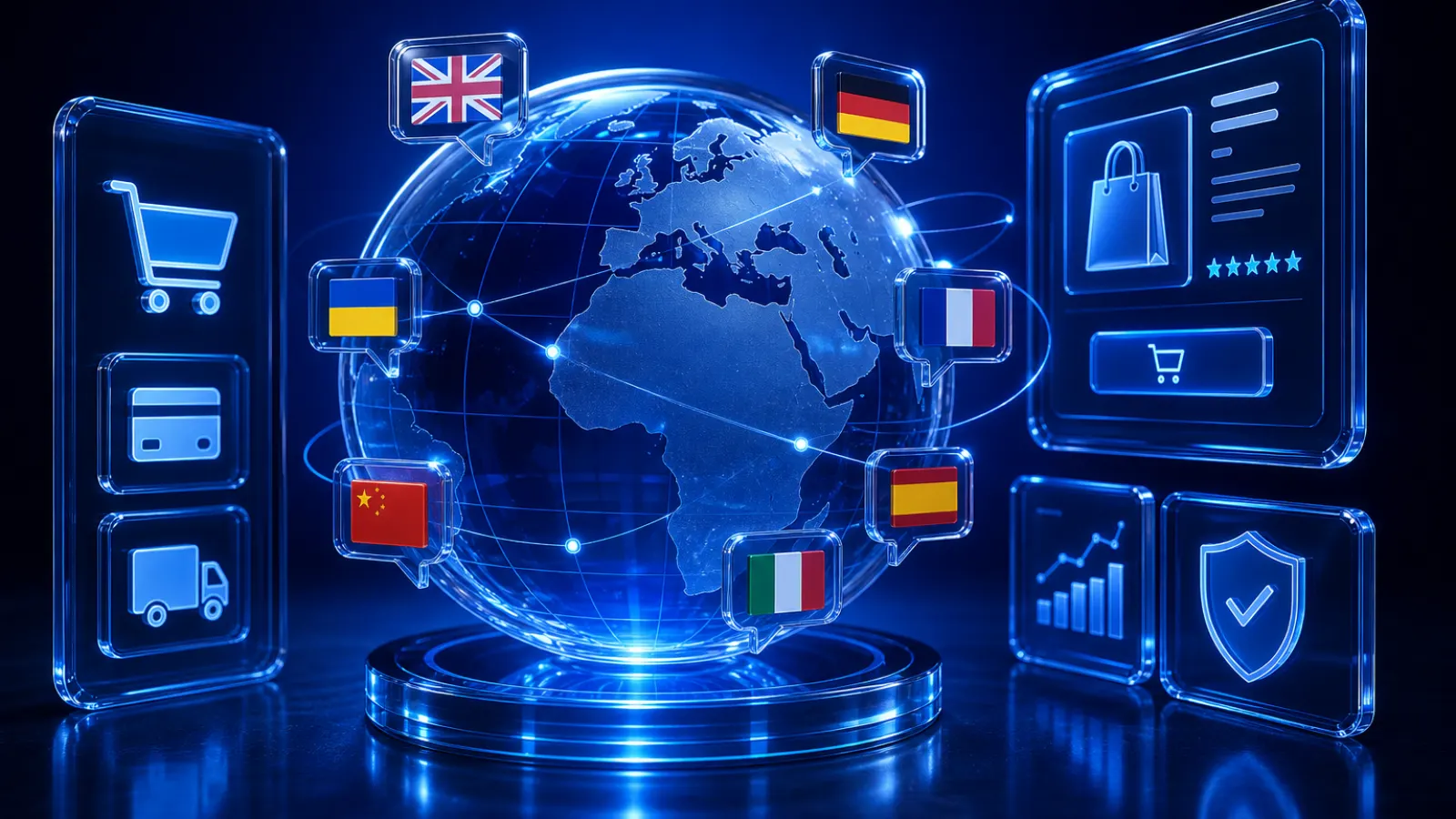
A multilingual online store is not just a translation of pages; it is a strategic tool for entering international markets and expanding your customer base. It allows users to interact with content and make purchases in different languages, which is key to global growth.
Creating such a platform requires a deep understanding of not only technical aspects but also the cultural, legal, and marketing nuances of each target region.
Why Multilingualism is Crucial
The shift to multilingualism is not just a trend but a necessity for companies seeking growth. It opens doors to new markets, increases customer loyalty, and optimizes operational processes. Our experts at ShockWave Trade emphasize that a successful multilingual store is a synergy of strategy, technology, and localization.
Key Benefits:
- Market Expansion: Access to a wider audience and new geographical regions.
- Increased Conversion: A user-friendly interface in a native language significantly improves user interaction and stimulates purchases.
- Brand Strengthening: Demonstrating respect for the cultural peculiarities of different countries.
- Cost Optimization: Reducing customer service costs by being able to communicate in their language.
Key Steps Before Starting a Project
Before delving into technical implementation, thorough preparation is crucial. This is the key to success and efficient resource utilization.
- Clear Definition of Business Goals: What exactly do you want to achieve? Increased international traffic, higher LTV (Customer Lifetime Value), reduced support costs, or entry into specific markets (e.g., EU, North America, Asia)?
- Detailed Market and Audience Analysis: Identify which languages and regions have the highest profit potential for your business. For example, in Ukraine, Ukrainian and English are often key, but for export operations, Polish, German, or Spanish might be needed.
- Technical and Content Audit of the Current Platform: Evaluate the capabilities of your current Content Management System (CMS), product structure, and current SEO status.
- Budgeting and Roadmap Development: Determine necessary investments (platform, translation, integrations), estimate ongoing support costs, and expected return on investment.
- Consideration of MVP Approach: For complex projects, it is advisable to start with a Minimum Viable Product (MVP) to confirm demand and test core hypotheses before a full-scale launch.
- Defining Partnership Strategy: Decide which tasks will be handled by internal resources and which will be outsourced to external teams or specialists.
Step-by-Step Plan for Implementing a Multilingual Store
STEP 1: Defining Target Languages and Localization Level
- Conduct a conversion and demand analysis in your existing market to identify the most profitable languages for further expansion.
- Determine the depth of localization: whether only UI and content translation is needed, or also adaptation of images, packaging descriptions, documentation, return policies, pricing, and customer support.
STEP 2: Choosing URL Architecture and Language Version Deployment Strategy
- Consider the main approaches: subdomains (uk.example.com), subdirectories (example.com/uk/), or ccTLD (country code Top-Level Domains, e.g., example.ua). For effective SEO and centralized management, subdirectories are often recommended.
- Ensure a clear URL structure and set up redirect rules to prevent issues with duplicate content.
STEP 3: Selecting Platform and Technologies
- Evaluate your requirements: catalog volume, necessary integrations (ERP, CRM, WMS, TMS), payment options, as well as speed and scalability requirements.
- Popular options include: SaaS platforms (e.g., Shopify Plus) for quick launch, WordPress + WooCommerce for flexibility, Drupal for content-heavy projects, or Headless architectures for large, scalable solutions.
- Experience from market peers shows that migrating between platforms, such as transferring from Shopify, requires careful planning to preserve SEO metrics.
STEP 4: Organizing Content Translation and Localization Processes
- Define the optimal translation model: involve professional linguists for key pages and products, and for large catalogs, combine machine translation with post-editing. Important: do not rely solely on automatic translation for commercial descriptions.
- Create a brand terminology glossary and style guidelines for each language to ensure a consistent tone of voice.
- Implement a Continuous Integration (CI – continuous translation) process: when a product description changes, a translation request should be automatically created.
STEP 5: SEO Optimization for Multilingualism
- Correctly implement hreflang tags: specify the language and region for each language version, and do not forget about self-referencing. Incorrect use of hreflang can lead to indexing problems.
- Avoid duplicate content: each language should have unique or well-localized content.
- Set up an XML-sitemap with all language versions and submit them to Google Search Console for the respective regions.
- Localize metadata (title, description) and URLs, if it is business-savvy.
STEP 6: Integration of Payments, Currency, and Delivery
- Ensure prices are displayed in local currency with automatic or fixed conversion rates.
- Integrate local payment gateways: for the Ukrainian market, these are Fondy and LiqPay; for international clients, add PayPal, Stripe, etc.
- Set up individual delivery rules and account for customs duties for each target region.
STEP 7: Data and Catalog Migration
- Carefully plan the transfer of products, categories, images, and reviews. For large catalogs, automate import/export processes.
- During migration, it is important to preserve the URL structure or set up 301 redirects. Practical experience shows that this is critical for maintaining SEO positions.
STEP 8: Testing, Localized QA, and Launch
- Conduct functional testing for each language version: check forms, currencies, payments, system messages.
- Be sure to perform linguistic QA: checking terminology, correctness of date/time formats, and legal texts.
- Plan a phased launch (possibly with a beta phase for specific regions) and constantly monitor Key Performance Indicators (KPIs).
STEP 9: Post-Launch Optimization and Analytics
- Set up segmented analytics by language and region. Track conversions, average check, and bounce rates.
- Optimize advertising campaigns and content according to user behavior in each language version.
- Implement systems for automatic translation updates and catalog synchronization.
Tips from Our Experts
- Focus on business results, not mechanical "site replication." Each additional language should demonstrate ROI or a strategic advantage.
- Use a PIM (Product Information Management) system for centralized catalog and localization management.
- For large catalogs, combine machine translation with post-editing, but use professional translation for key product cards and legal pages.
- Embed automated tests to verify all localized purchasing scenarios.
- Plan infrastructure scaling using CDN (Content Delivery Network) and caching to reduce latency for users from different countries.
Common Mistakes and How to Avoid Them
- Incorrect hreflang implementation: Errors often occur with missing self-references or incorrect language/region codes. Solution: Thorough testing via Google Search Console and using validators.
- Complete reliance on machine translation: This can lead to loss of trust and reduced conversion. Solution: Use a combined approach with page prioritization.
- Ignoring UX localization: Unadapted design can disrupt Calls to Action (CTAs), truncate texts, or cause confusion in forms. Solution: Conduct UI/UX testing in target languages.
- Lack of update process: If content is updated in only one language, other versions quickly become outdated. Solution: Integrate a workflow for processing translations with any changes.
- Insufficient attention to payment and delivery: A customer may abandon the cart if there is no convenient local payment method or transparent delivery information. Solution: Integrate local payment solutions and display all costs at early stages of purchase.
Expected Results
- The first noticeable changes in traffic and sales can be observed within 3–6 months after launch, provided a correct SEO strategy and quality localization.
- ROI (Return on Investment) depends on the level of investment in translation and marketing. A basic multilingual version (2–3 languages) usually pays off faster than simultaneous scaling to many markets.
- Improvements in LTV and reduction in CAC (Customer Acquisition Cost) are possible due to localized support and convenient local payment methods.
When to Contact a Specialist?
Creating a multilingual online store is a complex project that requires expert knowledge. Consulting specialists becomes critical in the following cases:
- Your catalog contains over 1,000 products, or you plan integration with complex systems (ERP, PIM, WMS).
- It is necessary to preserve SEO positions during migration or to set up complex redirects. Our experts have experience in planning and executing such transfers, considering both SEO and business goals.
- If you need to develop a Headless architecture or custom integrations of payment/logistics solutions for specific markets.
Practical Examples and Tools
- Translation Management Tools: Lokalise, Crowdin, Phrase. For automation, integrate machine translation APIs with a post-editing workflow.
- PIM Systems: Akeneo, Pimcore – useful for centralizing product information.
- CDN and Caching: Cloudflare, Fastly – critically important for ensuring fast access in different regions.
Key Terms
For a better understanding of the topic, here are the key terms:
- MULTILINGUAL ONLINE STORE: An online platform that provides user experience and content in multiple languages.
- HREFLANG: An HTML attribute that informs search engines about the language and regional version of a page, helping to avoid duplicate content issues.
- PIM (Product Information Management): A system for centralized management of product data, simplifying its localization and updates.
- HEADLESS ARCHITECTURE: A technological approach where the external interface (front-end) is separated from the internal part (back-end), interacting via API. Provides flexibility and scalability.
- L10N (Localization): The process of adapting content to the cultural, legal, and linguistic specificities of a particular market, going beyond simple translation.
Questions and Answers (FAQ)
Here are answers to the most common questions about multilingualism:
Q: Do I need a separate domain zone for each language?
Not necessarily. Subdirectories are often better for centralized SEO and management. ccTLDs (e.g., .ua, .de) provide a stronger regional signal but require separate SEO efforts and maintenance for each domain.
Q: Can catalog translation be fully automated?
Machine translation can be used for large volumes, but for key products and legal pages, professional translation with post-editing is recommended. Full automation without control can negatively impact conversion due to inaccuracies.
Q: How to avoid traffic loss during migration?
Key is meticulous planning of 301 redirects, preserving the URL structure, or creating a detailed redirect map. Be sure to test everything before launch and closely monitor indexing after the transition.
Q: Which payment systems should be connected for Ukraine?
For the Ukrainian market, Fondy and LiqPay are basic options. For export and international clients, international gateways such as Stripe and PayPal should be added.
Q: How many languages is optimal to launch at once?
It is recommended to start with 2-3 languages that have the highest business potential to refine processes and strategies before scaling to more markets.
Conclusion: A multilingual online store is a multi-step project that combines product strategy, technical architecture, translation processes, and SEO. For a business owner or CEO, the key is to define clear business goals, prioritize languages based on validated demand, and choose a scalable and manageable architecture. Treat the launch as an investment: measure KPIs, automate routine operations, and invest in a localized customer experience – then your multilingual store will become a reliable source of stable growth for your business.