Selecting the right niche for an online store is the cornerstone of future success, especially amidst continuous changes in the e-commerce market. Analysts at ShockWave Trade are convinced that technology is merely a tool; true value is created by a business model capable of generating profit, optimizing logistics, and offering customers a unique experience that sets the store apart from large marketplaces.
Since 2011, our team has accumulated significant experience in developing hundreds of e-commerce and B2B projects. This allows us to approach niche selection not only from the perspective of current trends but also considering the possibility of building a sustainable business. Key aspects that interest us include: forming an effective assortment, automating warehouse processes, encouraging repeat orders, scaling advertising campaigns, optimizing for search engines, and minimizing manual order processing.
In 2026, the Ukrainian consumer is extremely demanding. They actively compare prices, read reviews, verify sellers, make purchases from smartphones, and choose the most convenient delivery methods. Product search is also evolving: in addition to traditional Google, buyers turn to marketplaces, social networks, and AI services like ChatGPT to compare features and select products.
Thus, a successful idea for an online store in 2026 must meet several criteria: stable demand in the category, healthy sales economics, the ability to offer something unique compared to marketplaces, and potential for developing a proprietary brand.
The Most Promising E-commerce Niches for 2026: An Expert Review
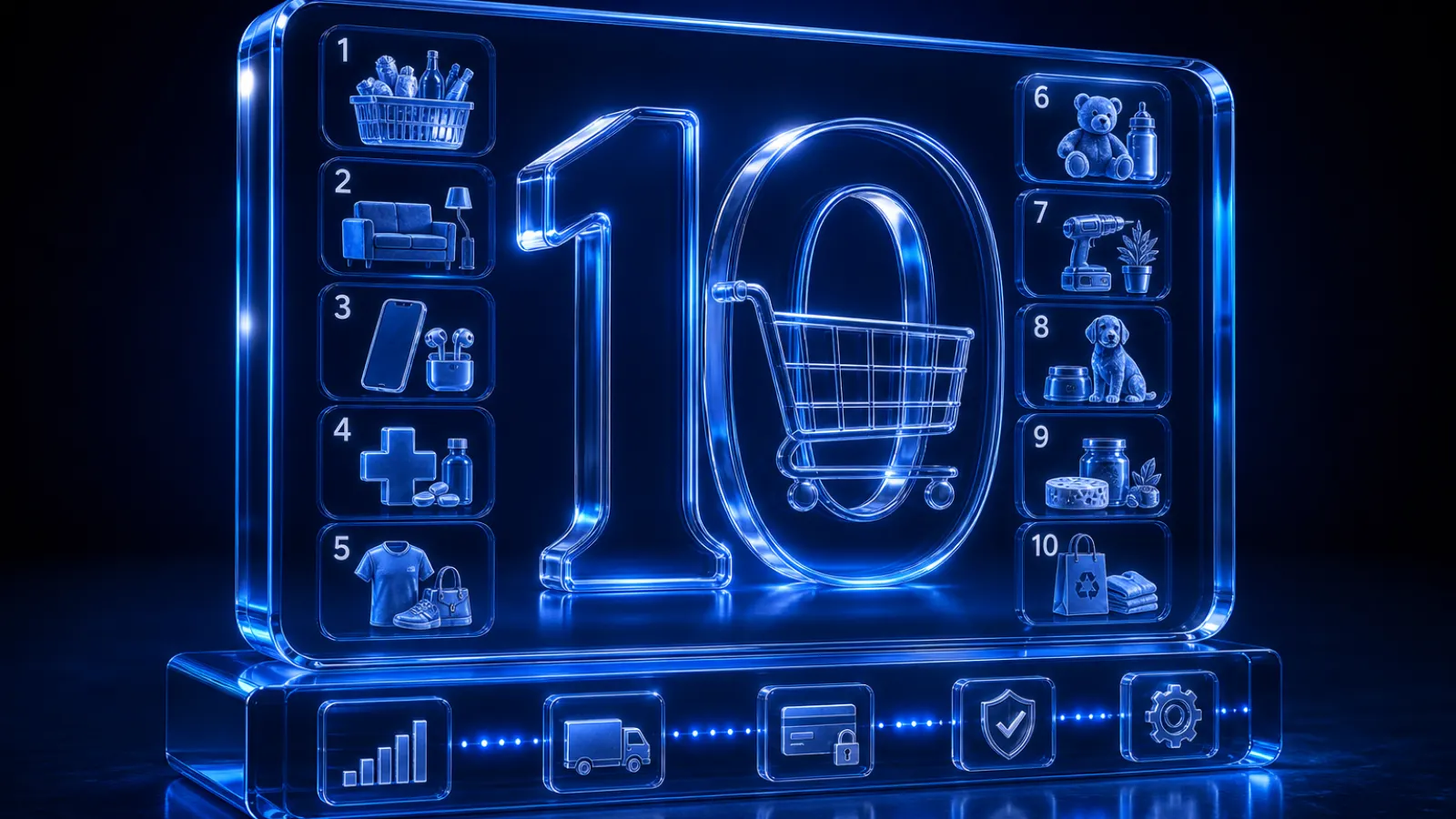
Based on our analysis, the following areas are worth considering in 2026:
- Pet supplies and regular consumption products for pets.
- Home goods, storage systems, and space organization.
- Tools, components, and repair materials.
- Car products, accessories, and consumables.
- Niche cosmetics and personal care products.
- Electronics, accessories, and autonomy products.
- Niche apparel and functional accessories.
- Specialized food and beverages.
- Sports, tourism, hobby, and outdoor recreation goods.
- B2B stores for business consumables.
It is important to understand that this is not a strictly ranked list. Success in any of these niches depends on many factors. For example, a pet store can be highly profitable for an entrepreneur with reliable suppliers, but risky for someone who plans to compete solely on the lowest price. The same applies to electronics, cosmetics, or automotive products.
Our key recommendation: choose not just a product, but a market where you can create an optimal purchasing process for the customer.
Criteria for Evaluating E-commerce Ideas
According to Prom.ua data, among the categories with the highest number of online orders in Ukraine, tech and electronics, home and garden goods, auto and moto products, clothing and footwear, and beauty and health products lead the way. The platform also notes active growth in the segments of food and beverages, pet supplies, tools, repair materials, and construction products.
However, high demand does not always guarantee business success, as it is often accompanied by high competition.
Before launching a project, we recommend evaluating a niche based on six key parameters:
- Demand: Is there a constant demand for the product, not just a seasonal or short-term spike?
- Repeat Purchases: Is there potential for customers to return after a certain period (month, quarter, half-year)?
- Profit Margin: Is there sufficient profit left after all operating costs, including advertising, shipping, and returns?
- Competition: Are there compelling reasons for a buyer to choose your store over large marketplaces or market leaders?
- Logistics: How costly are storage, packaging, shipping, and potential returns of the product?
- Scalability: Is there an opportunity to expand the assortment, automate processes, and increase order volumes without a proportional increase in staff?
There is another important factor that is often underestimated: access to goods. Having a direct contract with a manufacturer, proprietary production, exclusive import, or deep expertise in a narrow category can be significantly more important than any ranking of popular niches.
1. Pet Supplies Online Store
Pet supplies remain one of the most promising niches for detailed analysis in 2026. Their main advantage is not in fashion trends, but in the high frequency of repeat purchases. Food, treats, litter, grooming products, and other consumables run out regularly. If a store provides adequate prices, fast delivery, and considers the pet's parameters, the customer will have no need to search for a new supplier every month. This creates a strong foundation for long-term customer relationships.
Our analysts do not recommend launching another generic "everything for all pets" store. It is much more effective to start with a clear specialization, for example:
- Products for specific dog breeds or sizes.
- Premium foods and natural treats.
- Cat products with a regular delivery system.
- Aquarium supplies.
- Grooming products.
- Equipment for traveling with pets.
Personalization works excellently in this niche. Storing information about the animal's type, breed, age, weight, allergies, and previous purchases allows the store to recommend suitable products, remind about repeat orders, or offer comprehensive sets. For such a business, the technological platform directly impacts the LTV (customer lifetime value). Necessary features include subscriptions, one-click reordering, CRM triggers, a loyalty program, and accurate inventory management.
2. Home Goods, Storage, and Space Organization
The home goods category has significant potential due to the ease of expanding its assortment. A customer who bought a kitchen organizer might later order wardrobe storage systems, lighting, textiles, kitchen accessories, or bathroom items. The average check can be increased through carefully selected comprehensive offers, rather than aggressive pop-ups.
However, we advise against the concept of a "store for everything home," as competing with marketplaces on a wide catalog will be extremely difficult.
It is better to focus on solving a specific problem, for example:
- Space organization in small apartments.
- Kitchen goods.
- Smart storage solutions.
- Home office setup.
- Minimalist decor.
- Terrace and garden products.
Content is extremely important in this niche. It's not enough for the customer to see a photo of a box. It's crucial to demonstrate how an organizer looks in a 60 cm wide wardrobe, how many items it holds, how a shelf is mounted, and the internal dimensions of a container. This approach is also useful for SEO, as instead of hundreds of identical supplier cards, the store gets pages that provide complete answers to user queries.
3. Tools, Equipment, and Repair Supplies
This niche shows significant potential for specialized stores. A buyer looking for a drill bit, fasteners, power tools, or a component is usually more interested in compatibility and functionality than an attractive brand.
This creates a unique advantage, as large general stores often struggle to provide the necessary level of detail and expertise. The catalog can be structured by equipment models, work types, materials, and technical parameters. The customer selects their tool and sees only compatible consumables. For B2B clients, wholesale prices, quick reordering functions, invoices, and personalized terms can be integrated.
Possible promising directions:
- Power tools and consumables.
- Fasteners.
- Professional hand tools.
- Electrical installation products.
- Plumbing components.
- Workshop consumables.
- Small-scale production equipment.
In this category, a high-quality internal search is especially valuable. Users may enter not only the exact product name but also the tool model, article number, size, or queries like "125 mm tile cutting disc." For large technical catalogs, it is advisable to consider search systems that work not only with exact word matches but also with parameters, synonyms, and user intent.
For such projects, deep integration of the catalog, filters, and search is critical.
4. Car Products and Automotive Accessories
The automotive category is very extensive, but launching a general auto parts store from scratch is risky due to complex catalogs, critical compatibility, and high competition. In contrast, highly specialized stores have much more interesting prospects.
For example:
- Car chemicals and care products.
- Accessories for specific car brands.
- Organizers and trunk products.
- Automotive lighting.
- Floor mats and interior protection.
- Travel accessories.
- Chargers, holders, and automotive electronics.
A successful store in this niche must have information about the buyer's car. After selecting the make, model, year, and modification, the system should automatically filter out incompatible items. This is a clear example of why custom development is often more advantageous than using standard templates. A proprietary compatibility database can be integrated with the catalog, CRM, accounting system, and supplier data, allowing managers to avoid manual verification of each order.
5. Niche Cosmetics and Personal Care Products
The beauty sector remains a large online segment, but simply opening another cosmetics store is not enough. In this niche, the buyer seeks not only a product but also a solution to a specific problem: dry skin, sensitivity, colored hair care, SPF protection, beard care products, or professional cosmetics for specialists.
Therefore, we recommend building a store around expertise. Instead of a typical "creams / shampoos / masks" catalog, you can offer selection by skin type, tasks, active ingredients, brands, and product compatibility.
Promising formats include:
- Dermatocosmetics.
- Korean or Japanese cosmetics.
- Professional hair care products.
- Men's grooming.
- Products for beauty industry professionals.
- Sensitive skin care.
The product card must provide as much information as possible: who the product is intended for, how to use it, what to combine it with, volume, composition, country of origin, and storage conditions. Such detail makes the page useful not only for the customer but also for search engines and AI services that analyze product characteristics.
6. Electronics, Accessories, and Autonomy Products
Electronics enjoy consistently high demand but also face very fierce competition. Launching a standard smartphone store without a unique selling proposition is unlikely to succeed. Niche specialization is a different story.
For example:
- Network equipment for home and small business.
- Chargers and GaN adapters.
- Cables and adapters.
- Smart home devices.
- Backup power systems.
- Batteries and components.
- Home office equipment.
- Accessories for a specific device ecosystem.
In this niche, selling bundles has great potential. Users often find it difficult to study numerous technical specifications to choose a power supply for a laptop or a backup power kit for a router. The store can ask a few questions and generate a ready-made kit, providing a service rather than just a catalog. Technically, this requires advanced filters, comparison functions, links between compatible products, recommendation systems, and high-quality search.
7. Niche Apparel Instead of Another Fashion Store
Clothing and footwear consistently experience high online demand, but this also makes competition in this niche one of the fiercest. A new store without its own brand, unique product, or clearly defined target audience will quickly find itself in a situation where discounts are the only way to attract customers.
We recommend narrowing the niche. For example:
- Apparel for tall or petite individuals.
- Plus Size clothing.
- Maternity and nursing wear.
- Workwear.
- Medical attire.
- Functional clothing for tourism.
- Basic locally produced clothing.
- Apparel for a specific sport.
A narrow audience might seem like a disadvantage at first glance, but in practice, it simplifies marketing. You better understand customer needs, can create more precise content, offer accurate sizing charts, and provide products not found in general stores.
If a brand is being created from scratch, check the name and domain for simplicity, uniqueness, and compatibility.
8. Specialized Food and Beverages
Online food sales are attractive due to high demand for repeat purchases. However, we do not advise competing with supermarkets in the basic grocery basket. It is much more logical to sell products for which customers are willing to turn specifically to a specialized store.
Examples:
- Coffee and tea.
- Craft sweets.
- Long-shelf-life farm products.
- Spices and sauces.
- Products for specific diets (vegan, gluten-free, etc.).
- Meal preparation kits.
- Gourmet gift sets.
The most interesting model here is built around repeat orders. If a customer regularly buys the same coffee, the website should allow them to reorder in a few seconds. Subscription models can also be developed: a monthly coffee set, a box of new flavors, or regular delivery of a basic assortment. For such a model, CRM and automation are almost as important as the website itself. The store should track the last purchase date, the average interval between orders, and the assortment that the customer usually buys together.
9. Sports, Tourism, and Hobby Goods
Stores built around a community or specific hobby are very promising because they possess something universal marketplaces lack: context. For example, a bicycle store doesn't just sell a pump. It understands which valve is used, what pressure a specific tire needs, which tubes are compatible, and what else to take on a long ride.
The same applies to other niches:
- Camping.
- Fishing.
- Running.
- Cycling.
- Home fitness.
- Board games.
- Modeling.
- Painting and handicrafts.
Such niches are excellent for SEO content. Queries often arise long before a purchase: "how to choose a tent," "which reel to buy," "how to select a cycling helmet," "what a beginner needs for watercolors." If the store provides a quality answer, the user becomes acquainted with the brand even before they are ready to place an order.
10. B2B Consumables Store
This e-commerce idea is often underestimated because it appears less glamorous than clothing, cosmetics, or gadgets. However, from a technical and business perspective, B2B e-commerce can be extremely interesting. Companies constantly purchase packaging, gloves, paper, labels, cleaning products, office supplies, components, tools, disposable materials, HoReCa goods, and manufacturing supplies.
Key advantage: if the supplier performs well, the client can order for months or even years. However, a standard online store is often unsuitable here. B2B clients may require:
- Personalized pricing.
- Different access levels for employees.
- Order approval by a manager.
- Payment by invoice.
- Deferred payment.
- Quick ordering by SKU.
- Order upload from Excel.
- Document history.
- Repeat previous orders.
- Custom catalog for a specific client.
This is precisely the case where a custom e-commerce platform is often justified. The online store becomes an integrated part of the company's internal sales system, rather than just a product showcase.
Comparative Analysis of 10 Niches
The table below provides a general overview of the characteristics of different niches. It is important to remember that this is only a starting point for analysis, and each niche has numerous sub-niches with their own specific features.
| Niche | Repeat Purchases | Catalog Complexity | Competition | Automation Potential |
|---|---|---|---|---|
| Pet Supplies | High | Medium | High | High |
| Home Goods | Medium | Medium | High | Medium |
| Tools & Repair | Medium / High | High | Medium / High | High |
| Car Products | Medium | High | High | High |
| Cosmetics | High | Medium | High | High |
| Electronics & Accessories | Medium | High | Very High | High |
| Niche Apparel | Medium | Medium | High | Medium |
| Food & Beverages | High | Medium | Medium / High | High |
| Sports, Tourism, Hobbies | Medium | Medium / High | Medium | Medium |
| B2B Consumables | Very High | High | Depends on segment | Very High |
This table does not replace in-depth market research. Its main purpose is to highlight which aspects to consider before investing in inventory.
How to Validate a Niche Before Developing an E-commerce Store
One of the most expensive mistakes is investing significant funds in website development, product procurement, and warehouse rental without first validating market demand. we recommend operating on the opposite principle.
Checking Search Demand
Gather basic semantics using tools such as Google Keyword Planner, Ahrefs, or Serpstat. It is important to analyze not only the frequency of the main query but also the entire cluster. For example, for a coffee store, not only "buy coffee" queries are relevant, but also queries by brewing method, country of origin, roast, brand, variety, package weight, and purpose.
Marketplace Analysis
Platforms like Prom, Rozetka, and others provide a wealth of valuable information. Research the number of sellers in the category, their assortment, the number of reviews, price range, and which products regularly appear in popular listings. It is important not to copy leaders but to identify their weaknesses and seek your own competitive advantages.
Calculating Single Order Economics
Even before starting website development, you should have an approximate financial model: purchase price → markup → customer acquisition cost → packaging → shipping → payment commissions → returns → operating expenses → net profit. Turnover without sufficient margin does not make a business successful.
Supplier Assessment
It is crucial to determine: can current inventory levels be automatically obtained? How often do prices change? Is there an API, XML, or CSV for integration? What is the minimum purchase volume? What is the policy regarding warranty returns? The answers to these questions will define the architecture of the future store.
Which Platform to Choose for an Online Store in 2026
There is no universal answer to the platform selection question. We are not advocates of the "everyone needs custom development" approach. If you are testing a new niche with a small assortment, standard payment methods, and a single delivery service, a complex custom system might be overkill. However, the opposite extreme is also dangerous: when a business, launched on a simple platform, grows, connects a warehouse, CRM, multiple suppliers, marketplaces, a separate B2B price list, a bonus system, and a mobile application, after a few years, every new feature requires another plugin, and data is scattered across five systems.
Shopify and Other SaaS Platforms
SaaS solutions are ideal for quickly launching a standard store. Hosting, basic infrastructure, and most features are already built-in. This is a good option for small D2C brands, product testing, or expanding into international markets. Limitations arise when business processes significantly differ from standard ones, and a large number of third-party modules increases dependence on external services.
WooCommerce
WooCommerce is a logical choice for stores where WordPress is already used as the primary CMS, or where content plays a key role. There are many ready-made modules, developers, and integrations, which is sufficient for small and some medium-sized businesses. However, a large catalog, complex pricing, intensive inventory synchronization, and dozens of plugins require very careful architecture; otherwise, the store becomes difficult to maintain.
OpenCart
OpenCart remains relevant for classic stores with standard logic. It is simpler than many enterprise solutions and has a large number of ready-made modules. Problems arise when a business needs non-standard processes, complex integrations, or an architecture planned for active development over many years.
Magento / Adobe Commerce and Enterprise Platforms
These systems are designed for complex catalogs, large teams, integrations, and serious e-commerce processes. However, they are more expensive to implement and maintain, making them excessive for small stores.
Custom Development
Custom e-commerce makes sense when business logic itself becomes a competitive advantage. For example, if a store needs to:
- Receive inventory from multiple warehouses.
- Synchronize prices with an ERP system.
- Work with multiple suppliers.
- Automatically distribute orders among warehouses.
- Display different prices to B2B clients.
- Calculate non-standard delivery.
- Have its own bonus system.
- Transfer data to CRM, WMS, and accounting.
- Have a complex product compatibility system.
- Operate simultaneously with a website, marketplaces, and a mobile application.
In such projects, we prefer an API-oriented architecture. The online store should not be the sole repository of all business data but becomes one component of the overall ecosystem. This approach is used by us when integrating e-commerce with 1C and ERP systems, combining catalog, payment, logistics, CRM, ERP, and warehouse accounting.
Why Warehouse Integration is More Important Than Attractive Design
The customer sees the design, while the business owner works with the backend daily. If a manager receives an order, manually checks supplier inventory, transfers the client to CRM, creates an invoice, changes the order status, and writes off goods from stock, then the website does not automate sales; it merely creates an additional entry point for requests.
The optimal scheme looks different: the customer places an order, the system automatically checks inventory, the order goes to CRM or ERP, the warehouse receives a fulfillment task, delivery is arranged, statuses return to the website, the customer receives notifications, and inventory is updated across all sales channels. We discussed these scenarios in more detail in our article on e-commerce integration with CRM.
With 20 orders a day, manual processing might seem acceptable, but with hundreds of orders, it becomes a serious operational problem.
What a Modern Online Store Should Be Like in 2026
In 2026, it is not enough to just have a homepage, catalog, product card, and "Buy" button. This is merely a minimal framework. A modern store must be significantly more functional.
Fast Mobile Version
Store design should start with the mobile version, then adapt to desktop. The catalog, filters, search, gallery, product variant selection, and checkout process must be easy to use with one finger, without the need for page zooming or closing banners.
Convenient Catalog and Filtering
Filters must reflect the logic of the specific product. For laptops, this means processor, memory, screen size, and graphics card. For cosmetics – skin type, action, and active ingredient. For car products – compatibility with the car. A universal set of filters does not work here.
Smart Search
With a large assortment, search becomes a key navigation element. It must understand errors, article numbers, brands, models, synonyms, and characteristics. For large-scale catalogs, it is worth using semantic search and AI-ranking.
Comprehensive Product Card
A high-quality product card should answer all customer questions before they even arise. It should contain:
- A clear name.
- Real photos.
- Price and availability.
- Product variants.
- Key characteristics.
- Detailed description.
- Payment terms.
- Delivery options and times.
- Warranty.
- Return policy.
- Compatible products.
- Reviews.
- FAQ for complex products.
For Google, it is also critically important to correctly transmit structured Product and Offer data: price, currency, availability, and other product information, which helps search engines to more accurately understand the page and use it in product search formats.
Simple Cart and Checkout
Do not force customers to create an account before payment if it is not a critical business requirement. Do not ask for ten fields when five are sufficient. In the cart, the customer should clearly see the product, quantity, final price, shipping, discount, and the next action. We recommend reviewing our analysis of how to reduce abandoned carts and optimize the checkout process.
Payment and Delivery for the Ukrainian Buyer
The website must support the payment methods actually used by its audience: bank cards, Apple Pay, or Google Pay via appropriate payment services, as well as cash on delivery where necessary. For a Ukrainian store, it is logical to integrate delivery service APIs, selection of city, branch, or parcel locker, cost calculation, and status tracking.
Personal Account
A personal account is especially useful where repeat purchases occur. The customer should have access to order history, statuses, bonuses, saved addresses, documents, and the ability to reorder. In the B2B segment, functionality can be much broader: personalized pricing, credit limits, invoices, contracts, company user management, and approval levels.
Personalized Recommendations
Recommendations like "customers who bought this item also bought" are effective only when the products are truly related. In 2026, e-commerce is moving towards personalized output, where the system considers previous purchases, views, customer parameters, and cart contents. However, we do not advise starting an AI project with a recommendation model if the store lacks high-quality and sufficient data. First – catalog, attributes, order history, and analytics, then – machine learning.
Business-Level Analytics
The number of visitors alone is not an indicator of success. It is important to track:
- Conversion rate.
- Revenue.
- Margin.
- Average order value.
- Customer acquisition cost.
- Repeat purchases.
- LTV (customer lifetime value).
- Returns.
- Internal site search queries.
- Stages at which customers abandon the checkout process.
These metrics allow for informed decisions regarding further functional development.
Preparing an Online Store for AI Search in 2026
This is one of the key changes that we advise considering when launching a new e-commerce project in 2026. Buyers may no longer search for "best camping tent" and manually open dozens of websites. They might ask ChatGPT, Gemini, or another AI assistant: "Find a two-person tent under 6000 UAH for spring and autumn hiking."
For products to be easily understood by machine systems, the catalog must have a high-quality data structure. The name "Model X123" is insufficient. Comprehensive information including name, characteristics, product type, brand, GTIN or SKU, price, availability, variants, material, size, delivery, and return information creates a much clearer description. Google actively uses structured Product and Offer data to generate product search results. In global e-commerce, agentic commerce is simultaneously developing, where an AI system can not only find a product but also help navigate a significant part of the purchasing journey.
We do not advise building a Ukrainian store around a feature that may not yet be available to a specific user or market. But preparing the catalog, structured data, and API for machine use now is a perfectly logical step. This is the same principle we apply to using LLMs within companies. The quality of input data is more important than the mere fact of AI integration, as we explained in more detail in our article on using LLMs in business.
What to Avoid in 2026 Without a Clear Advantage
There are categories with huge demand, but this very fact makes them dangerous for newcomers. we advise extreme caution when entering niches such as general smartphone stores, generic fashion, cheap unbranded Chinese accessories, mass-market cosmetics, typical home goods, and other categories where dozens of sellers offer identical SKUs. The problem is not with the product, but with the fact that the buyer sees a multitude of identical offers and chooses based on price. A new store immediately enters a price war with companies that have better purchasing terms, cheaper logistics, and thousands of reviews. However, if you have an exclusive supplier, your own brand, strong content, unique service, an offline point, special bundling, or another significant advantage, the situation changes drastically.
Marketplace or Own Online Store: What to Choose?
We do not believe one must choose only one. A marketplace is excellent for validating demand and getting initial orders, as it already has an established audience. A proprietary store solves a different problem: it provides full control over the brand, SEO, customer behavior data, CRM, repeat sales, and the entire customer journey.
For many companies, the optimal model in 2026 looks like a combination: marketplaces + own store + social media + Google Merchant Center + CRM as a unified system for customer management. It is crucial that inventory and prices synchronize, and managers do not manually transfer each order between systems.
SEO for a New Online Store: Design Before Launch
A common mistake is to develop a store and then invite an SEO specialist to "set up SEO." By this point, incorrect URLs, duplicate filters, dozens of indexed technical pages, and a catalog that does not match search demand may already have been created. SEO affects the website's architecture.
Before development, it is desirable to understand:
- Which categories are necessary.
- Which subcategories have separate search demand.
- Which filters should be open for indexing.
- How URLs are formed.
- How canonical links are implemented.
- What happens to a product after it disappears from sale.
- How Product structured data is formed.
- How the store submits products to Merchant Center.
- How sitemap.xml is created.
- How internal linking works.
In 2026, another requirement is added to classic SEO: information must be clearly structured for AI systems. Characteristics should not be hidden within images or arbitrary text; they must be presented as normalized data. The approach to modern web architecture and SEO is also discussed in our article on Headless E-commerce.
When to Opt for Custom Development
Custom development is needed not because it is "more premium," but when a standard platform begins to force a business to change its processes due to system limitations. We strongly recommend individual architecture if at least several of the following conditions are present:
- Tens of thousands of SKUs.
- Multiple warehouses.
- Multiple inventory sources.
- ERP or WMS integration.
- Simultaneous operation with B2B and B2C clients.
- Personalized pricing.
- Non-standard delivery logic.
- Marketplaces and offline points.
- Complex product compatibility system.
- Mobile application.
- Subscription systems.
- Complex loyalty program.
- Proprietary recommendation system.
- AI-powered search.
- Plans for active scaling.
A custom system allows for separate development of the storefront, catalog, checkout, integrations, and backend. If a new sales channel emerges tomorrow, the entire store does not need to be rebuilt. However, the architecture must be designed to meet real requirements. Headless, microservices, and complex middleware are not necessary for a store with 200 products simply because these terms sound modern in a technical presentation.
Preparation for Ordering Development: Our Checklist
The better a business owner understands their operational model, the more accurately the future store can be evaluated. Before the first technical discussion, we recommend preparing:
- A list of product categories.
- Estimated SKU count now and a projection for 2-3 years.
- A list of suppliers.
- Methods for obtaining price and inventory information.
- A description of warehouse operations.
- A list of delivery services.
- Preferred payment methods.
- Currently used CRM, ERP, or accounting systems (if any).
- Key sales channels.
- B2B requirements (if applicable).
- Required countries and language versions.
- Expected load.
- Key customer behavior scenarios.
At the initial stage, there is no need to write a hundred-page technical specification. It is more important to clearly formulate business processes, and the technical model will be built around them.
The Formula for Choosing an Online Store in 2026
When asked which online store to open, we advise against starting with a search for the "most profitable product of 2026." It is much more effective to look for the intersection of four key aspects: demand + access to goods + economics + the ability to create a better buying experience.
For example, pet supplies have strong potential for repeat sales. Tools allow for success through technical expertise and compatibility. B2B consumables can ensure long-term customer relationships. Niche apparel allows for building a strong brand around a specific audience. In contrast, a copy of a large general store without its own competitive advantage will be a challenging business, regardless of design quality.
FAQ: How to Choose an Online Store in 2026
Which online store should I open in Ukraine in 2026?
We recommend analyzing pet supplies, home goods, tools and repair, car products, niche cosmetics, specialized electronics, niche apparel, regular consumption products, hobby goods, and B2B consumables. The choice should be based on thorough verification of demand, competition, profitability, logistics, and supplier access.
Which online store is the most profitable?
There is no single "most profitable" category. A store with lower revenue but high margins and repeat purchases can be more profitable than a large store with high customer acquisition costs. Models with repeat purchases are especially interesting because the business does not pay the full customer acquisition cost for each subsequent order.
Which online store ideas are suitable for a beginner?
It is easier for a beginner to start with a narrow assortment, straightforward logistics, and products without complex warranty service. For example, a specialized store for hobby goods, home organization, pet supplies, or a local brand might be easier to test than a full-fledged electronics or auto parts store.
Should I start with dropshipping?
Dropshipping can be a way to test demand without significant warehouse costs. However, it is necessary to control inventory accuracy, shipping speed, packaging quality, and returns. For the customer, supplier problems are your store's problems.
Do I need my own website if I can sell on a marketplace?
A marketplace provides access to a ready audience, while your own store gives control over the brand, SEO, CRM, analytics, and repeat sales. For companies planning long-term development, combining these channels is a stronger model than complete dependence on a single marketplace.
Which platform is best for creating an online store?
For a small, standard store, Shopify, WooCommerce, or OpenCart can be considered. For complex catalogs, B2B, multiple warehouses, ERP/WMS integration, personalized pricing, and non-standard business processes, custom or hybrid development is advisable. The platform should be chosen after a detailed description of business processes.
How many products are needed to start?
There is no minimum quantity. A niche store can successfully start with a few dozen carefully selected items. Having 10,000 SKUs is not an advantage in itself. For the customer, it is more important whether they find the desired product and receive enough information to make a decision.
What is more important at the start: design or functionality?
Functionality and ease of purchase are priorities. Design should support them. A fast website with a clear catalog, a quality product card, and a simple checkout process usually benefits the business more than a complex visual concept with slow navigation.
Does a new online store need AI?
Not necessarily from the very beginning. First, a quality catalog, structured characteristics, analytics, search, and automation of basic processes are needed. AI-powered search, recommendations, and personalization should logically be integrated when there is sufficient data and a specific problem that the technology needs to solve.
Conclusion
In 2026, we advise against searching for a "magic niche" with low competition, high demand, and huge margins – such opportunities rarely go unnoticed. A much more realistic strategy is to meet existing demand with better quality: narrow the catalog, assist with selection, automate repeat purchases, provide more product information, integrate the website with the warehouse and CRM, develop an effective search, and minimize manual processing. The question "which online store to open" always consists of two parts: what to sell, and why it will be more convenient for the customer to buy it specifically from you.